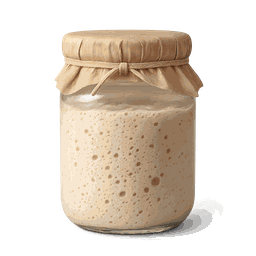
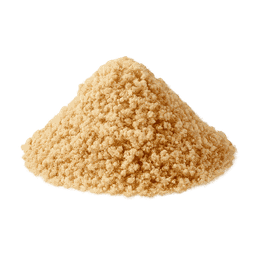
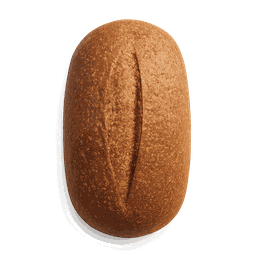
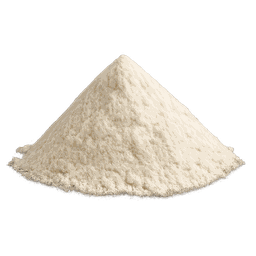
This sourdough bread recipe produces a chewy and full-flavored artisan boule with an open crumb and a nicely caramelized crust. Adapted from Nancy Silverton. Read the notes below before starting this recipe!
0 Stir together the ingredients in a large bowl in this order until a rough dough forms. Add more bread flour if your dough is very wet. Scrape the dough out onto a lightly floured surface (a stiff, plastic scraper is perfect for this), invert the empty bowl over the dough, and let it rest for 20 minutes. (This is called autolyse and allows the flour to absorb some of the water and the gluten strands to begin straightening out; it makes for less kneading in the end, and will prevent you from adding too much flour right off the bat.)
1 After 20 minutes, remove the bowl and knead the dough vigorously for about 10 minutes, adding as little flour as possible to prevent the dough from sticking to your hands and the surface, until it feels smooth, springy and elastic.
2 Place the dough in a large, lightly oiled ceramic bowl or a large plastic container at least twice the size of the dough. You can mark the outside of the vessel with a piece of masking tape where the dough will be when it doubles, if you like. Cover the vessel tightly with plastic wrap or the lid, and allow it to rise until doubled, three to four hours. The warmer the spot you choose, the faster it will rise, the ideal temperature being 75-85º. You can also let the dough rise in the fridge or a cool place overnight. Let the dough come to room temperature before shaping it, and be sure that it has doubled in bulk to properly develop the glutens.
3 Gently turn the dough out onto a lightly floured surface, pressing out the air bubbles. Shape into a boule by tucking the edges under itself, then gently rotating the dough on the surface to form a taught outer layer of dough. Here's a quick video of how to shape a boule.
4 If you have a rising basket, sift a light layer of flour onto the inside, and place the boule in it upside-down, pinching the seam shut. (If you don't have a rising basket, place the boule directly on a peel or board dusted with cornmeal or flour.) Place the whole deal in a large plastic bag, such as a trash can liner. Inflate the bag and close it with a twist tie or clip. Let the bread rise a second time until doubled, about 1 1/2 - 2 hours.
5 When the bread is ready to bake, it will hold an indentation of your finger when you press it lightly, rather than springing back. While the bread is rising, about an hour before you're ready to bake, remove all but the bottom rack of your oven. Place a baking stone on the rack (or a heavy duty baking sheet), and place a metal pan that you don't care about sacrificing (it will get rusty) on the floor of the oven. Crank the oven up to 500º.
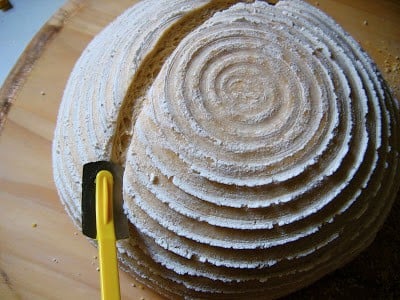
6 When the bread has doubled, gently turn it out onto a wooden peel dusted with flour or cornmeal. Holding a lame or sharp knife at a 45º angle to the loaf, draw the blade, about 1" deep, across the top of the loaf, beginning and ending 2" from the bottoms of the boule. (Just look at the darn picture, ok?) Fill a 1 cup measure with ice cubes. Quickly slip the boule off the peel and onto the stone, and toss the cubes into the hot pan on the floor of the oven. This will steam the outside of the loaf, allowing it to expand as it bakes.
7 Bake 20 minutes, then turn the oven down to 450º and bake another 20 minutes or so, until the bread is a deep, burnished golden-brown. An instant read thermometer inserted into the middle should read 210º, the temperature at which the dough is set.
8 Let cool completely on a wire rack, one to two hours, before enjoying. At this point, the bread is still "baking" from the residual heat and steam inside the loaf. The best way to store this type of bread is in a paper bag at room temperature for a couple days. After that, I put the whole thing, paper bag and all, into a plastic bag and continue to store at room temp. After a couple of days like that, it there's any left over, we make croutons.